
In a previous article working in Maldives as a dive instructor, I explained how to find a job and what to expect when working as a dive instructor in the Maldives. But getting your first job is just the beginning.
The real question most instructors ask after their first year or two is different: Can this become a long-term career, or is it just a seasonal job with a beautiful view?
In this article, we go deeper in how this could actually turn into a potential career. I’ll break down the real salary structure, the career progression from instructor to management, and the skills you must develop if you want to build stable, growing income while living and working in the Maldives.
The Salary Package for Dive Instructors in the Maldives
Working as a dive instructor in the Maldives offers in most places a structured income, divided in several components. Many people imagine that instructors earn high salaries only because they work in luxury resorts.
Sometimes it is true, but let’s look together at the salary structure for instructor.
Most dive instructors in the Maldives receive a compensation package made up of four main components:
Fixed Base Salary
This is the guaranteed monthly amount stated in your contract. It does not change based on how busy the resort or dive center is.
Compared to Western standards, the base salary is lower, but it provides stability when the low season is hitting or when the resort has less occupancy.
Service Charge
Service charge is distributed from the overall revenue (usually is 10% on all activities) of the resort, if you work directly under the resort or from Dive Center revenue if you work with a third party company.
This means your income can increase during high season when occupancy is strong and decrease during low season. It also means the more you are busy and the more you will earn. It creates variability in your monthly earnings.
Usually it can variate from $300 to $1000 more.
Commission / Revenue of Share
Many resorts and third-party dive companies offer commission to motivate instructors to promote dive courses and increase the overall revenue of the dive center. In addition to the base salary, instructors may receive commission on the courses they teach and sometimes a percentage of the total revenue generated by the department.
In theory, this system allows instructors to increase their salary by selling more courses and contributing to higher revenue, and it often encourages them to work extra hours. In practice, however, commission and revenue share depend heavily on guest flow, seasonality, and the level of responsibility given to the instructor within the dive center.
Tips
While there is no guarantee and tips should just counted as an extra/bonus it can be a decent amount especially in 5 Star Resorts during high season.
How Much Can a Dive Instructor’s Salary Increase With Experience in the Maldives?
In the Maldives, a dive instructor’s salary can increase with experience, but the increase is usually small and depends mainly on the company you work for. In most cases, only the base salary goes up slightly over time, while commission, service charge, and tips do not change significantly.
For this reason, many instructors see a real salary increase only when they change resort (depending if the revenue of that specific resort is higher), gain more responsibilities, or move into senior or management positions.
You can save all your salary
In the Maldives resort system, instructors usually get double-share accommodation, meals, and an allowance for a back-and-forth flight. Since most daily expenses are covered, it is possible to save a good portion of your salary, especially if you don’t spend much on restaurants or the tuck shop (cigarettes have become extremely expensive just recently).
This is what makes the Maldives financially interesting. Salaries are not extremely high compared to Western standards, but the low personal expenses combined with a stable income allow many instructors to save more than they would in other countries.
Why Many Dive Instructors Stay Stuck and Burned Out?
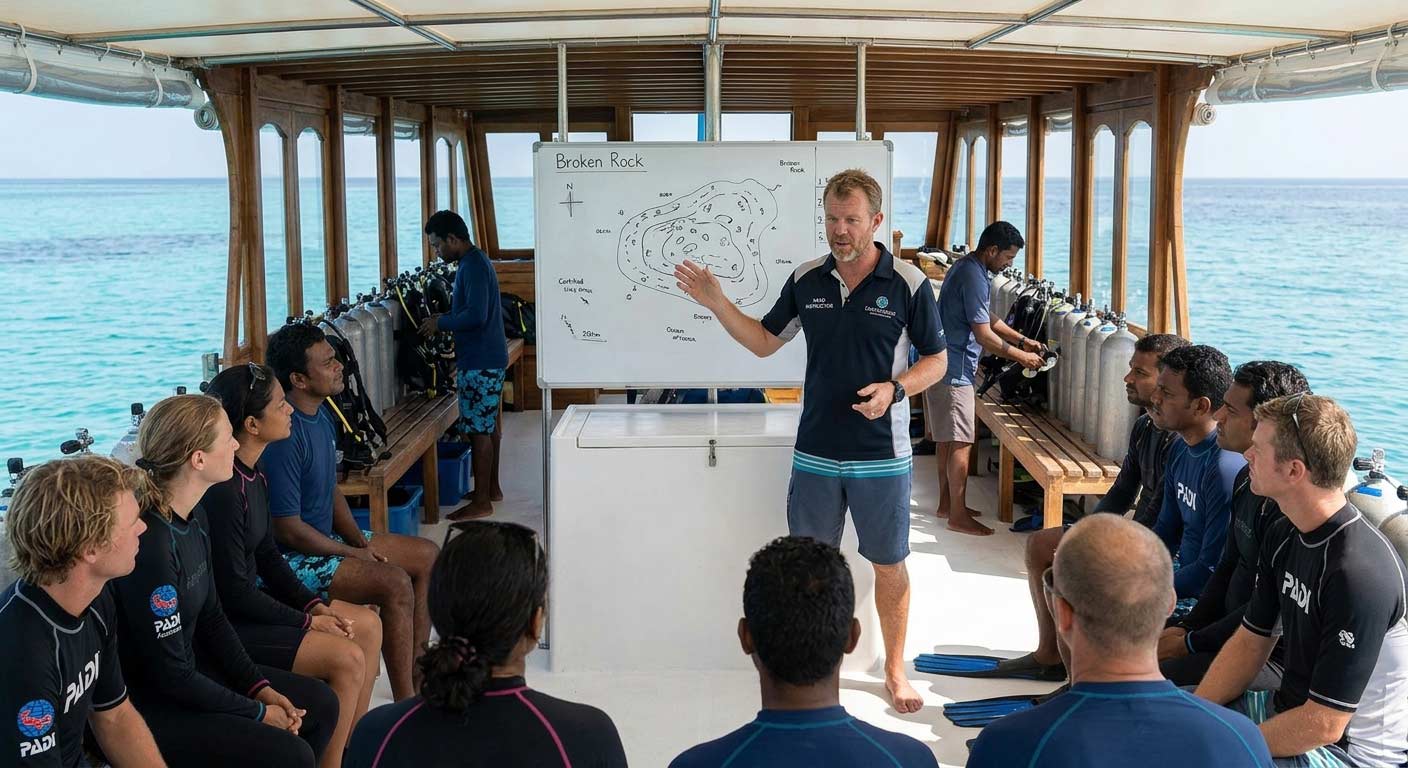
After a few years in the industry, many dive instructors start to feel stuck and burned out.
What begins as a dream job, diving every day in a tropical paradise, can slowly become repetitive. The same dive sites, similar courses, long working hours, and constant guest interaction can take a toll over time.
At the same time, salary growth is often limited, and real career progression is not always clear. Many instructors remain in the same position for years, without significant financial improvement or new challenges.
This is where frustration starts to build. Without change, growth, or new opportunities, it becomes easy to lose motivation and feel stuck in a cycle that is hard to break.
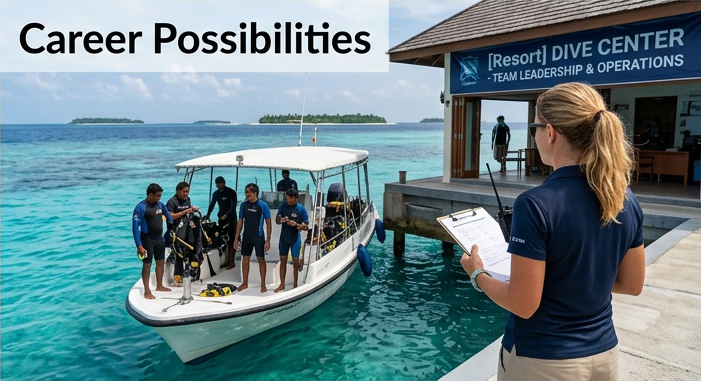
What Career Opportunities Are There in a Dive Center in a Maldives Resort?
Working in a dive center in a Maldives resort can offer more career opportunities than many instructors initially expect, especially compared to dive centers in other tropical countries.
While most people start as Dive Instructors ( PADI Open Water Scuba Instructors or higher) there is often room to grow into more senior roles over time.
If you are looking for current opportunities in the industry, Job-Maldives is also a useful place to check for dive instructor and management positions specifically for the Maldives
These can include positions such as Senior Instructor, Assistant Manager, or even Dive Center Manager.
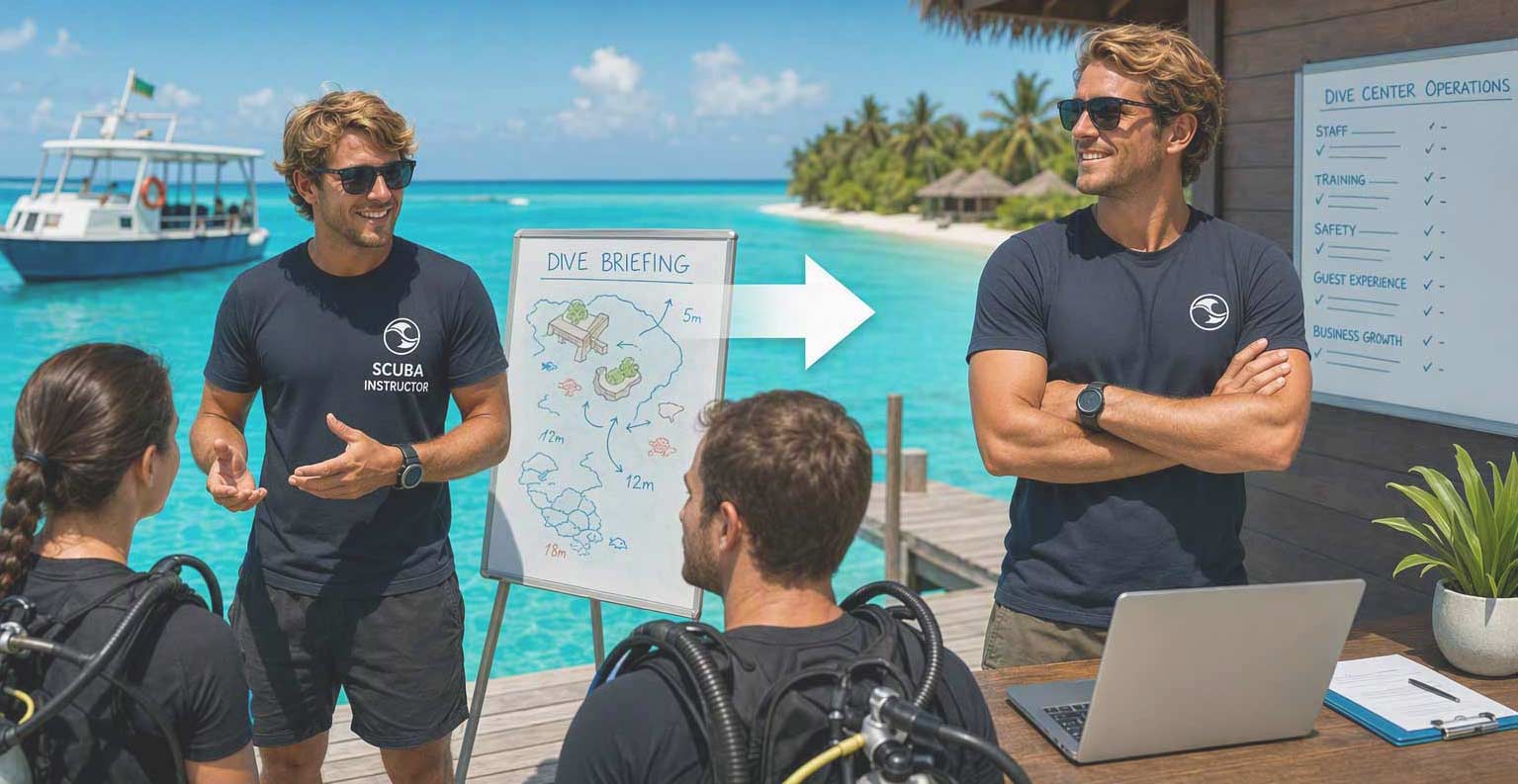
In addition to teaching, instructors can take on more responsibility in areas such as guest relations, equipment management, staff training, and daily operations. Those who show strong sales skills, leadership, and reliability are usually the ones who move up faster.
However, these opportunities depend heavily on the size of the dive center, the company structure, and the willingness of the individual to take on extra responsibilities beyond teaching.
Should You Stay With the Same Company or Change Jobs to Progress?
There are two main ways to build a career in the Maldives dive industry.
You can stay with the same company and grow within the organization, or you can move between different companies to reach higher positions.
Both options can work, and the best choice depends on the company, the resort and the opportunities available.
Growing Within the Same Company
Staying with the same company can be a very good way to build a long-term career, especially when you work for a large company with several resorts or dive operations.
Larger companies often have more opportunities for internal promotion. You may start as an instructor, move to Senior Instructor, then Assistant Manager and eventually Manager. There may also be opportunities to move to another property within the same company and take on a bigger role.
One advantage of staying with the same company is that they already know you. If you have performed well and have built a good reputation, management already knows your skills, your work ethic and how you deal with guests and staff.
For this reason, when looking for a long-term career, I would recommend looking at some of the larger companies with multiple operations, rather than only looking at the individual resort.
Sometimes There Is No Room to Move Up
However, there are also situations where staying in the same operation for too long can slow down your career.
Some resorts have very stable teams and very low staff turnover. This can be a good working environment, but it can also mean that the people above you stay in their positions for many years.
When that happens, there may be a kind of queue for promotion.
You might be ready to become an Assistant Manager, but if the current Assistant Manager has no reason to leave, there may simply be no position available.
You can continue doing a great job, but your career may not move forward because there is no space above you.
Sometimes Moving to a Smaller Company Is the Better Choice
In this situation, moving to a smaller company or smaller resort can actually be a smart career decision.
You may be able to take a higher position much earlier, such as becoming an Assistant Manager or Manager, even if the company is smaller and the salary is not necessarily better.
At first, this can feel like a step backwards financially.
For example, you could leave a well-paid instructor position and accept a management position in a smaller operation for similar money or even slightly less.
But you should not always look at this only as a salary decision.
You are gaining something else: management experience.
Having “Manager” or “Assistant Manager” on your CV can make a big difference when you later apply to larger companies.
Think of It as an Investment in Your Career
Sometimes you need to make a short-term sacrifice to improve your long-term position.
Taking a lower-paid management job can be an investment in your career if it gives you the experience you need to move into a better position later.
After gaining one or two years of management experience in a smaller operation, you may then be able to apply for the same position in a much larger company or luxury resort.
The salary and benefits can be significantly better, and you now have the experience to justify the position.
This is one of the strategies I believe can work very well in the Maldives: move sideways or even slightly backwards financially in the short term to move much further forward in your career later.
Know When It Is Time to Move
The important thing is not to change jobs just for the sake of changing.
Before moving, look at what you will actually gain from the new position.
Will you get more responsibility? Will you manage people? Will you learn more about the business? Will you have better opportunities in the future?
Sometimes the best job is not the one with the highest salary today. It is the one that puts you in the best position for the job you want tomorrow.
That is why I would always look at the next step, rather than only looking at your current salary.
A good career in the Maldives can be built by staying loyal to the right company, but it can also be built by moving strategically when your current operation no longer gives you room to grow.
Dive Instructor Salary Vs Dive Managers Salary and Benefits
Dive instructors in the Maldives typically earn a base salary of around $900 per month.
On top of this, they usually receive a service charge, which can range from $200 to $400 in quieter resorts, and up to around $1,000 in high-end or busy properties.
In some cases, instructors also receive commission or a share of revenue. In the best situations, this can bring the total monthly income to around $2,000, with additional tips depending on guests and luck.
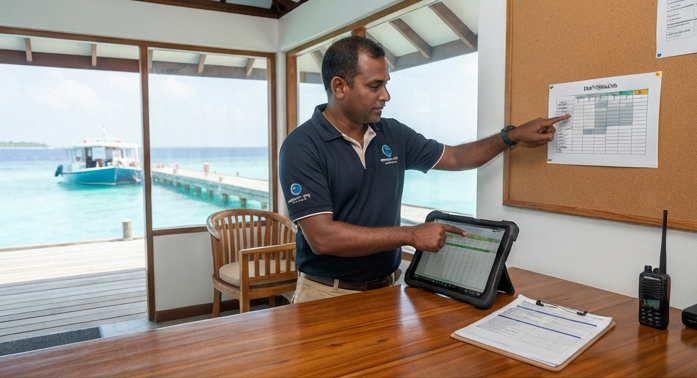
For management positions, salaries are higher.
Assistant managers usually start at around $1,200, while dive center managers can earn up to $2,000 as a base salary.
With service charge and revenue share included, total earnings in the best resorts can reach between $3,000 and $3,500 per month.
When it comes to benefits, there are also some differences. Dive instructors and assistant managers often share accommodation, while in better resorts assistant managers and managers may receive single accommodation.
Managers are usually allowed access to guest restaurants and laundry services for personal clothing, while these benefits are sometimes extended to instructors and assistant managers only in higher-end resorts.
Flight benefits depend on whether you are employed directly by the resort or through a third-party company.
Resort contracts typically cover the full cost of return flights to your home country, even if prices increase.
Third-party companies, on the other hand, usually offer a fixed flight allowance, which may not adjust if flight costs rise.
Managers are also more likely to receive R&R (rest and relaxation) benefits, which include an additional flight ticket and extra leave days.
In some resorts, these benefits are also extended to instructors and assistant managers.
In general, most contracts offer around 30 days of annual leave, plus public holidays and one day off per week, regardless of position.
Does Promotion Always Mean Higher Income?
Moving to a higher position does not necessarily mean that you will earn a higher overall salary package.
This was also my experience when I first moved from Dive Instructor to Assistant Manager in another resort.
Even though the base salary was higher, as expected, the service charge I received was much lower compared to what I was earning in my previous resort.
There were also no additional benefits. I was not allowed in guest restaurants, did not have a single room, and had no extra perks.
This changed when I later moved to a larger company, where both the benefits and the overall package almost doubled.
So, a lot depends on the resort and the company you work for. Sometimes, however, to reach these larger and better-paying companies, you first need to gain experience in smaller ones.
The Skills That You Need to Get Promoted and Succeed to Next Level
Moving from a scuba diving instructor to an assistant manager or dive center manager requires more than just good diving skills.
You need to develop several other skills before you are ready to take responsibility for a team and the whole operation.
Excellent Diving Knowledge
Your diving knowledge needs to be excellent. As a manager, you need to be able to understand currents, wind, tides, weather and different dive conditions.
You should also know as many dive sites as possible. You do not necessarily need to have dived every single site, but you should know enough about them to explain to new instructors how they can dive the site, what conditions they can expect and what they need to be careful about.
You also need to be able to read the conditions and make decisions based on currents, wind and weather. As a manager, you will often have to give this information to your instructors and help them decide how a dive should be planned.
Leadership Skills
When you become a manager, you are no longer responsible only for yourself and your guests. You are also responsible for your team.
You need to be able to teach and guide other instructors, correct mistakes and explain things clearly. You need to understand that not everyone has the same level of experience, so you need to know how to work with different people.
A good manager should help the team improve, not just tell people what to do.
Computer and Administrative Skills
Computer skills become very important when you move into management.
You will deal with many emails, spreadsheets, bookings, reports, documents and schedules. You need to be comfortable using programs such as Excel or Google Sheets and be able to manage information properly.
Being organized is very important. You may have hundreds of emails and many different files, so you need to be able to find the information you need quickly.
The Ability to Handle Many Things at the Same Time
A manager can have many things happening at the same time.
You may have a guest asking for a private dive, an instructor needing help, a boat waiting to leave and an email from management that needs an answer.
You need to be able to manage several things at the same time, decide what is most important and react quickly.
Quick Thinking and Decision Making
Things do not always go according to plan in a dive center.
Weather can change, boats can be delayed, guests can make unexpected requests, instructors can get sick and equipment can have problems.
You need to stay calm and make decisions quickly. Experience helps you understand which problems need immediate attention and which ones can wait.
People Skills
You will deal with many different people every day. Guests, instructors, boat crew, reception, management and other departments all have different needs.
You need to be able to communicate well with everyone. You also need to know how to handle complaints, solve problems and deal with difficult situations without creating unnecessary conflict.
This is especially important in a luxury resort, where guest satisfaction is a major part of the job.
Continuous Learning
Becoming a manager does not mean that you stop learning.
You should continue improving your diving knowledge, leadership, computer skills, administration and understanding of the business.
You should also help your team continue learning and developing.
A good manager should always look for ways to make both themselves and their team better.
More Than Just Being a Good Instructor
The skills that make you a good instructor are not always the same skills that make you a good manager.
You need strong diving knowledge, but you also need leadership, organization, computer skills, good communication and the ability to make quick decisions.
The sooner you start developing these skills, the easier it will be to move from instructor to management when the right opportunity comes.
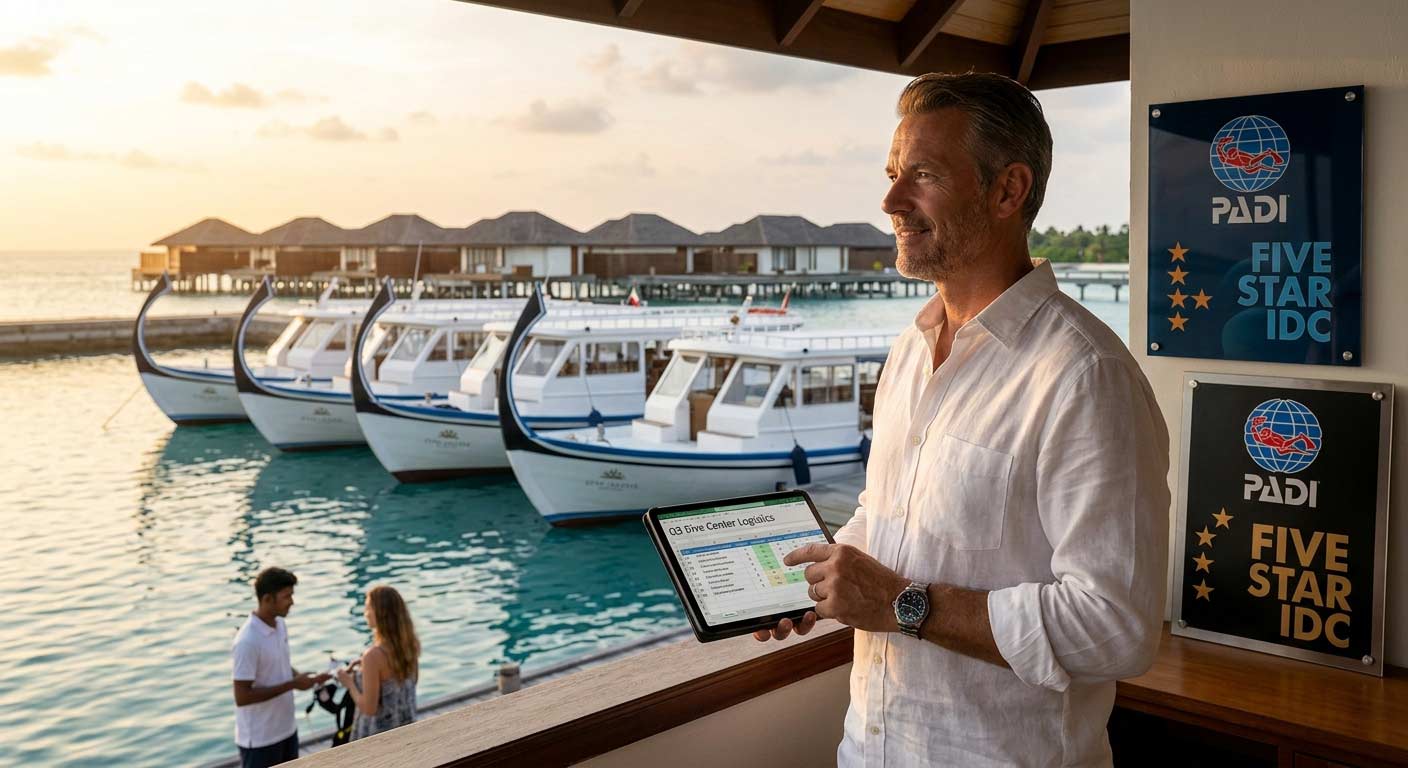
How to Increase Your Income While You Are Working in The Maldives
One of the biggest financial advantages of working in the Maldives is that you are not paying for many of the expenses you would normally have at home.
Accommodation, food, and in many cases your flights are covered by your employer. This means that, depending on your lifestyle, you can save a large part of your salary.
Instead of simply saving the money in your bank account, you can use these years to build something that can continue making money for you in the future.
For example you can invest in Properties and in the stock market.
Have a Clear Plan for the Next 3–5 Years
When I started working as a dive instructor, I did not have a clear plan for the next five years. However, looking back at my career now, I can see a pattern that worked well for me.
Having a simple plan can help you grow faster, avoid staying in the same position for too long, and make better decisions about your next job.
The following is the path I would recommend based on my own experience.
Year 1–2: Become a Good Instructor
During the first couple of years, your main goal should be to become a very good dive instructor.
I would recommend working in a 5-star resort if you have the opportunity. You are not only learning about diving, but also learning how a professional hospitality operation works.
During this time, you should improve your diving knowledge, learn how to read currents, understand wind and weather conditions, and become familiar with the different types of dive sites in the Maldives.
At the same time, do not focus only on diving.
Try to understand what happens behind the scenes.
Learn how the reception works, how bookings are handled, how billing works and how scheduling is organized.
Learn how your dive center communicates with other departments and how the operation is planned before the guests even arrive.
This is also a good time to improve your computer skills. Learn Excel or Google Sheets, Google Drive, Google Calendar and how to manage emails properly.
There are many free courses on YouTube and other online learning platforms, so you do not need to spend a lot of money to develop these skills.
Year 2–3: Start Taking More Responsibility
Once you are confident as an instructor, start looking for opportunities to take on more responsibility.
You can help with scheduling, equipment, bookings, staff training, guest relations and other parts of the operation.
The more you understand how the whole dive center works, the easier it will be to move into management later.
At this stage, you should also start thinking about your first management position.
It can be difficult to become a manager directly in a large luxury resort, especially if you have never managed people before.
This is why smaller companies and smaller dive operations can sometimes be a very good step.
Year 3–4: Move Into Management
After two or three years as an instructor, start looking for an Assistant Manager or Manager position.
Your first management job can feel overwhelming.
Suddenly you are responsible for other people, schedules, guests, equipment, problems and many things happening at the same time.
You need to learn how to deal with different personalities, listen to your staff and solve several problems while remaining calm.
In the beginning, you may spend a lot of time thinking about every problem before deciding what to do.
With experience, this becomes much easier. You start recognizing similar situations and finding solutions much faster.
An important part of becoming a good manager is also learning how to prevent problems before they happen.
Year 4–5: Move to Bigger Operations
After gaining a few years of management experience, you can start looking for larger operations and better companies.
At this point, you should have experience not only as a diver and instructor, but also in administration, hospitality, leadership and daily operations.
Moving to a dive center with 20 or more employees can be a big step.
You could try to enter a large operation from the beginning, but in my experience, progressing step by step can make the transition much easier.
Starting with a smaller operation allows you to learn management without being immediately overwhelmed by a large team and a more complicated operation.
Then, once you have built your experience and confidence, you can move into larger companies and take on bigger responsibilities.
Grow Step by Step
There is no single career path that works for everyone, but I believe that progressing step by step is one of the safest ways to build a long-term career in diving.
First become a strong instructor. Then learn the business side of the dive center. After that, learn how to manage people and operations.
Once you have built these skills, you will be in a much stronger position to move into larger companies, higher management positions and better salary packages.
You do not need to reach the top as quickly as possible.
The important thing is that every position you take should teach you something that prepares you for the next one.
Is It Possible to Work Long Term in the Maldives and Retire Somewhere Else?
After looking at salaries, career progression and how to manage your money while working in the Maldives, the final question is whether it is actually possible to build enough money to stop working in the dive industry one day.
The answer is yes, but I would not necessarily call it early retirement.
A more realistic goal is financial independence.
You may not build a huge pension by working in the Maldives for 10-15 years, but you could potentially build enough savings and investments to give yourself much more freedom later in life.
The Maldives Can Be a Tool to Build Your Future
This is how I would look at a long-term career in the Maldives.
The goal does not have to be working as a dive instructor forever.
You can use your years in the Maldives to build experience, move into better positions, increase your income and, most importantly, save and invest a significant part of what you earn.
After 10-15 years, you may still want to continue working. But you could be working because you want to, rather than because you have to.
The Maldives gives you an opportunity that few other jobs can offer: relatively low personal living costs while working in a beautiful environment and building a career.
What you do with that opportunity is ultimately up to you.